Wednesday, April 30, 2008

Rachel Klapp 3/3 Bio Blog from March that would not post

What we did today:
  • Took a few minutes to read up on our new unit "Human Systems." Reading on page 236
  • we then did some questions on page 238 1,2,4,5a,6ab,7ab
  • We then did a class demonsration with Craig,Krisit and I to better understand enzymes and catalyists.
  • We got a work sheet on fats, protiens and carbs.
  • We also did a lab on page 274. A pre lab quiz to start.

Questions and comments:

How many times does the average heart beat in a day?

Above and beyound:

What are some of the most interesting facts about the muscular system?

Muscles can account for about half your body weight. Muscles can only pull, they cannot, as some people assume, push. The longest muscle has muscle cells that can be over a foot long. The smallest muscles are in the middle ear; tensor tympani, and stapedius. The strongest, pound for pound, are the masseters, the chewing muscles.

Rachel Klapp 3/3

What we did in bio on Thursday:

  • We had double bio today.
  • The first block we watched a short video on the components of cells.
  • Second block we worked on our bio projects that are due next thursday, May 1st.
  • Sheets were handed out so you can stay on task and know where you are in your project.

Questions and comments:

  • What is the difference between a Killer T cell and a surpressor T cell?

Above and beyound:

Wednesday, April 23, 2008

Monday April 21 2008 3/3 Kimara Gratton

What we did today:

* Handed in blood assignment
* Reviewed questions d-g on page 372
* Played Blood typing game
* Took notes on the immune system
* Got started on our immune system project

Thoughts and opinions:
When we were doing the blood typing game i got really confused because stuff was clumping together and other stuff wasn't and i was like o i dont get it.. but its all good now because i realized if you think backwards it works out just fine:P


Above and beyond:

Who Has Which Blood Type?

TYPES

DISTRIBUTION

RATIOS

O + 1 person in 3 38.4%
O - 1 person in 15 7.7%
A + 1 person in 3 32.3%
A - 1 person in 16 6.5%
B + 1 person in 12 9.4%
B - 1 person in 67 1.7%
AB + 1 person in 29 3.2%
AB - 1 person in 167 0.7%

Mikki Johnston, April 23 3/3

What we Did today:
1. Listen to Chally talk about something. Ummm I think it was about sitting down or maybe about the field trip I can't remember...
2. Watch this super neat vidoe explaining the Immue system. It had these cool looking guys and such.("Your Magic Doctor" was the name of the cartoon)
3. got sheets so show our progress on out projects.
4. Then we went to the library to work on our projects.

Thoughts and opinions:
So the movie really helped cause it was a cartoon and I could pay attention to it, so I learn more about the Immue system. Having the time to work on our projects was good too!

Above and beyond:
As I was watching the cartoon I got to thinking about how the helper t cells call for help and such. This is what I found out:
"Helper T cells (effector T cells or Th cells) are the "middlemen" of the adaptive immune system. Once activated, they divide rapidly and secrete small proteins called cytokines that regulate or "help" the immune response. Depending on the cytokine signals received, these cells differentiate into TH1, TH2, TH17, or one of other subsets, which secrete different cytokines. CD4+ cells associated with MHC class II. " ----http://en.wikipedia.org/wiki/T_cell
Daniel's Belated Blog for April 18th/08 3/3


Talked about:


  • lymph nodes

  • tricuspid and bicuspid valves

  • Lub-Dub sounds

  • We also wrote the test on the circulatory system and the heart

  • we talked about blood typing and how different types are compatable with each other and some are not.


Thoughts & Opinions:


  • I felt well prepared for the test and I felt it was pretty easy. We had lots of time to cover the unit and get the right information. I am glad its done though.


Extra Insight


  • In search of enlightening material on the web, I managed to stumble across this horrifically disturbing picture of a man with a tumor that started on his lip and eventually consumed his entire face. At first you think this is the most disgusting picture you have ever seen. The second thing you think is why this happened? The lies within the Jehovah’s Witness religion. In this religion, blood tansfusions are taboo. When this man first got his tumor at age 14, a simple blood transfusion would have saved him from his terrifying fate. This is why you lock your front door when Jehovah's Witnesses come knocking.

Monday, April 21, 2008

Craig Bourgonje, March 21, 3/3

What we did today;
1. Marked Lab questions
2. Looked at animal Blood
3. Worked on questions and blood assignment

Thoughts and opinions;
While looking at a few animal blood sample's, it made me think; It is amazing how fast your body can make new blood cells and how many cells it needs to make in order to maintain a healthy blood level.

Above and beyond;
There is approximately 30 trillion red blood cells in your body, according to http://www.stemnet.nf.ca/~dpower/immune/blood.htm.

Watch the video to see the daily life of a red blood cell
http://www.youtube.com/watch?v=fQNrW8O9I10&feature=related
Monday, April 21/08
Cody Vewchar, April 4/08, 3/3

What we did today:
  1. We had a test on the Digestive System
  2. Watched a video called the River Of Life which involved the Circulatory System

Thoughts about the material:

While we were writing our test I was just wondering the whole time how long does it actually take food to reach your stomach from the time you begin chewing it and how long does the whole digestive process actually take.

Above and Beyond:

According to this website http://www.saburchill.com/chapters/chap0016.html food takes about one second to reach the stomach if its a liquid and 5 seconds if its a solid. According to that same website food can actually stay up to 96 hours in your large intestine. That's quite a while. Feel free to check it out.

Sunday, April 20, 2008

Hayley Tarnasky, April 22/2008 -- 3/3


The goings on of another interesting day in Biology 20!!!:


  • first off we were reminded that our permission forms for the cadaver ( science world) thing in edmonton on the tenth of june! whoot whoot!!!

  • Then we dove head first into the deep end of reviewing the vital parts of the heart

  • we recalled that deoxygenated blood is located in the right portion of the heart

  • and that oxygenated blood is in the left side

  • We went to page 320 and noticed that the pulmonary artery goes into the lungs

  • Also on that diagram was we realized that the pulmonary veins go from the heart to the lungs

  • As we continued our enthusiastic review, we remembered that the aorta is an artery

  • a capillary :are the smallest of a bodies blood vessels, measuring 5-10 μm in diameter, which connect arterioles and venules, and enable the interchange of water, oxygen, carbon dioxide, and many other nutrient and waste chemical substances between blood and surrounding tissues. (http://en.wikipedia.org/wiki/Capillary)

  • Mr. Challoner introduced the brilliant analogy of going from sundre to calgary ( grandma's house) This meant that when your driving on the QE2, you'r'e in an artery then you start going onto the side roads and they get smaller and smaller until you reach residential neighborhoods. There's another clue here, if you go down most roads in smaller areas, there's only room for one car, hence the blood only being able to down capillaries single file.

  • One of the last things we went over was the difference between the superior and inferior vena cava. Inferior- lower on the "heart totem pole" and the Superior is higher

  • We finally were winding down and we learned how to decifer the left side from the right side of the heart. When you look at a picture of the heart, the right side of the heart is your left side and vice versa

  • Lub Dub comes from the atria contracting and ventricles sending out blood to the rest of the body

Thoughts and Opinions


  • I thought it was very generous of Mr. C to allow us to review everything so that everything was decidedly as clear as mud ( haha)

  • By spending time reviewing and watching movies and videos and powerpoints, it really enhances our perspective and broadens our horizons.

  • How much friction does the blood cell cause?

Reach For The Sky!!!:


  • There is a ton of friction in a blood cell beause there is only so much space for the cell to go through so, if the capillary contracts at all, then this only increases the pressure on the cell, which in turn creates more friction from the cell moving through the blood stream.

  • So i got really curious and wanted to know what was the deal with heart burn! 'Cause even young people get it nowadays, especially when you eat macaroni to fast. So i put up the extra effort and heres what i found : Heartburn or pyrosis is a painful or burning sensation in the esophagus, just below the breastbone caused by regurgitation of gastric acid.[1] The pain often rises in the chest and may radiate to the neck, throat, or angle of the jaw. Heartburn is also identified as one of the causes of chronic cough, and may even mimic asthma. Despite its name, heartburn actually has nothing to do with the heart. It is so called because of a burning sensation of the breastbone where the heart is located although some heart problems do have a similar sensation to heartburn. Compounding the confusion is the fact that hydrochloric acid from the stomach comes back up the esophagus because of a problem with the cardiac sphincter, a valve which misleadingly contains the word "cardiac" (an adjective referring to the heart) in its name.

  • So ya, thats it for another day in the rather general bio 20 class!!!! WHOOOOO

Mitch Bach -- April 15, 2008 -- 3/3


What We Did:


  • Went over field trip forms

  • Filled out a heartbeat worksheet

  • Reviewed homework

  • Looked over temperature regulation in the body (fig. 4, pg. 333)

  • read/questions (pg. 336-8 q 2(337), 1(339))


Thoughts and Opinions


When we were going over the temperature regulation in your body, I wondered what the temperature of your body was. I also wondered what temperatures your body can "max out" at, in terms of the lowest it can be and the highest it can be until you die.


Above and Beyond


According to http://en.wikipedia.org/wiki/Body_temperature, core body temperature is 36.8 degrees Celsius or 98.2 degrees Fahrenheit. The highest that any fever has ever been brought up to was 108.3 F. While the lowest that a cold has ever gotten to is just a couple degrees Fahrenheit lower then homeostasis.


Tuesday, April 1, 2008

Melissa Schneider, April 1/08, 3/3

Whooo, April fools day!

What We Did Today;
  1. Discussed S.T.S. (Space Tourism Society? NO, it stands for Science and Technology Studies.... right?) and the variations in digestive systems, as well as "bad foods".
  2. "Ham Sammy" -- Started the assignment that consisted of writing a story of a ham sandwich going through the digestive system. (Due Thursday!)
  3. Went over the "thought lab" from Monday

Thoughts and Opinions;
  1. Wow, there is a lot of obesity in our society! Maybe there should be less pop machines and more water/juice drink machines?
  2. I never knew you could basically get a dog to salivate by ringing a bell.. wonder if humans can be taught to do that? :P
  3. How does a person get Celiac disease, and what are the symptoms?

Above and Beyond;
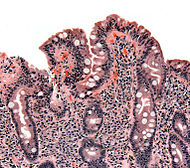
  • A person gets Celiac disease genetically (if your parents had it, you have a chance of having it yourself), but it doesn't present itself right away. Sometimes a person won't know they have it until they're an adult, and some might be diagnosed with it when they're a toddler. Celiac disease often shows itself after a stressful event such as surgery, childbirth, infection, or illness.
  • Some symptoms of Celiac disease are weight loss, fatigue, abdominal bloating, diarrhea, and anemia. If someone has these symptoms and go see their doctor, they will go through blood tests, or possibly even a bowel biopsy.
  • http://www.pamf.org/teen/health/diseases/celiac.html#How%20does%20someone%20get%20celiac%20disease?
  • Image: Sample of a bowel biopsy showing Celiac disease.

April Fool's Joke; "Classically Conditioning Craig to Salivate"

After hearing about Ivan Pavlov, a biologist/scientist who was able to classically condition dogs to salivate when they would hear a bell ring, Jen & Craig volunteered to go through an "experiment" to see if humans could start to salivate when hearing someone talking about food, and what Mr. C told them to do was:
Jen was to listen closely to Craig's stomach while Craig listened to Mr. C talk about Belgian waffles. Jen was listening for Craig's stomach to 'secrete gastric juices', but all she could hear was Craig laughing and Mr. C talking. We found out later that it was a joke. APRIL FOOLS!