Monday, June 16, 2008

Daniel's 3rd replacement blog for June 9/08. 3/3

Concepts:
  • Homogolous vs. analogous structures
  • Convergent / divergent evolution
  • inherited / aquired characteristics
  • DNA: simularities/differences
  • Early beliefs about evolution

Thoughts:

  • I think it makes a lot of sense that natural selection and mutations are mostly responsible for evolution.
  • i also think its interesting that species can evolve into different species if they're isolated.
  • Although we have tons of evidence to support the current theory of evolution, there is some evidence that challenges every thing we believe. this evidence is that of the crystal skulls. These skulls are apparently thousands of years old and could not have been made with primitive tools. the only way they could have been made is with some sort of power cutter. if these skulls really are thousands of years old, then it suggests there was once advanced civilization before us. I do a bad job of summarizing the whole story of it, so i strongly suggest to anyone reading that you should really check out the links below. each link is a part of a huge tv special about this mystery. check it out, it's enlightening!

Above and Beyond:

Monday, May 26, 2008

3rd Blog, Friday May 23, Tara Landsbergen, 3/3

What We Did Today:
  • Talked about aquatic and terrestrial ecosystems and factors that affect them
  • Crossword on ecosystems
  • Questions, Pg. 107 #1, 2, 3, 4, 7
Thoughts and Opinions:

  • What different organisms can withstand different levels of acidity in aquatic ecosystems?
Above and Beyond:

  • Trout- pH 5.0
  • Bass- pH 5.5
  • Perch- pH 4.5
  • Frogs- pH 4.0
  • Salamanders- pH 5.0
  • Clams- pH 6.0
  • Crayfish- pH 5.5
  • Snails- pH 6.0
  • Mayfly- pH 5.5

Wednesday, May 14, 2008

Hayley's Blog Continued


Thursday May 8 2008 Hayley Tarnasky 3/3

What did we do today?..........:
  • Hmmmmmm......
  • What 2 hormones associate with osmoregulation? We were asked this question and the answer is simple: ADH and aldosterone
  • Where do these hormones come from? Hypothalamus and adrenal gland
  • Read Page 387-390 and made notes (tons and tons and tons)
  • Nephritis- inflammation of the Nephron
  • Kidney Stones: caused by precipitation of mineral solutes from the blood
  • Dialysis: exchange of substances across a semi-permeable membrane
  • Two types: Hemo and Peritoneal
  • Transplants: nothing can surpass the real kidneys
  • Xenotransplants: from one species to another
  • Page 392 2,3,4,8,9
  • Watched a video on Hummingbird metabolisms and i thought it was cruel when they caught them but then i realized that they were simply using them for scientific research
  • Then we got to play Jeopardy and it was a relief to see my team on the positive spectrum this time

My opinion and any unanswered questions:

  • I thought this class was one of the better ones because for once i actually understood so that was nice
  • What is the metabolism of a Hummingbird?

Esma put your hands in the air!!!:

  • The metabolism of a hummingbird is roughly 100 times that of an elephant!!! Wow!! Thats one bird that does not need Red Bull ( although it already had wings)

Tuesday, May 6, 2008

Daniel's Blog, May 5/08

What we did today:
  • Talked about money for the field trip
  • Breathing rates
  • we took the respiratory system test
  • listened to the AMAZING rap song
  • saw Hayle's extensive web page
  • And to top it off, we witnessed Mr. Challonger mess up a lawyer joke

Thoughts/Opinions

  • i want to go see the body works exhibit, but the money and the long trip on the stinky cheese wagon make me decide otherwise
  • I wonder what the average breathing rate of a healthy adult is?
  • I thought the test was easy as long as you payed attention in class. i didnt even study lol
  • Props to the gals on the rap song. way to go. Craig-the-Retard sucks and should never sing again.

Above and Beyond

  • The average rate that a healthy adult breaths is 12 breaths per minute.
  • the average adult pair of lungs can hold 6 litres of air

Sunday, May 4, 2008

Thursday, May 2nd, 2008 3/3

What We Did Today:

  • Pop quiz on respiratory system. I think. Unless that was the day before, which is also possible.
  • Learned more stuff about the respiratory system - partial pressures, reviewed the mechanics of breathing, etc.
  • Finished watching Osmosis Jones.

Thoughts / Opinions:

  • I hate these bullet points.
  • How do these cilia in your trachea work, do they just hang out and stick around or do they wiggle or what do they doooo?

Above and Beyond!:

  • According to http://www.lung.ca/children/grades4_6/respiratory/how_we_breathe.html, "Millions of tiny hairs called CILIA act like tiny brooms to sweep out the bad stuff caught in the mucus. Each cilium sweeps back and forth about ten times every second! That's 36,000 every hour, 24 hours a day! They do this to keep your lungs clean."
  • I also just noticed that this is grades 4-6, so I guess I'm behind on these things and should have known?
  • Oh, I also found out that you have like six hundred million alveoli in your lungs. That's six hundred million grape-like sacs. That's almost disgusting.

Wednesday, April 30, 2008

Rachel Klapp 3/3 Bio Blog from March that would not post

What we did today:
  • Took a few minutes to read up on our new unit "Human Systems." Reading on page 236
  • we then did some questions on page 238 1,2,4,5a,6ab,7ab
  • We then did a class demonsration with Craig,Krisit and I to better understand enzymes and catalyists.
  • We got a work sheet on fats, protiens and carbs.
  • We also did a lab on page 274. A pre lab quiz to start.

Questions and comments:

How many times does the average heart beat in a day?

Above and beyound:

What are some of the most interesting facts about the muscular system?

Muscles can account for about half your body weight. Muscles can only pull, they cannot, as some people assume, push. The longest muscle has muscle cells that can be over a foot long. The smallest muscles are in the middle ear; tensor tympani, and stapedius. The strongest, pound for pound, are the masseters, the chewing muscles.

Rachel Klapp 3/3

What we did in bio on Thursday:

  • We had double bio today.
  • The first block we watched a short video on the components of cells.
  • Second block we worked on our bio projects that are due next thursday, May 1st.
  • Sheets were handed out so you can stay on task and know where you are in your project.

Questions and comments:

  • What is the difference between a Killer T cell and a surpressor T cell?

Above and beyound:

Wednesday, April 23, 2008

Monday April 21 2008 3/3 Kimara Gratton

What we did today:

* Handed in blood assignment
* Reviewed questions d-g on page 372
* Played Blood typing game
* Took notes on the immune system
* Got started on our immune system project

Thoughts and opinions:
When we were doing the blood typing game i got really confused because stuff was clumping together and other stuff wasn't and i was like o i dont get it.. but its all good now because i realized if you think backwards it works out just fine:P


Above and beyond:

Who Has Which Blood Type?

TYPES

DISTRIBUTION

RATIOS

O + 1 person in 3 38.4%
O - 1 person in 15 7.7%
A + 1 person in 3 32.3%
A - 1 person in 16 6.5%
B + 1 person in 12 9.4%
B - 1 person in 67 1.7%
AB + 1 person in 29 3.2%
AB - 1 person in 167 0.7%

Mikki Johnston, April 23 3/3

What we Did today:
1. Listen to Chally talk about something. Ummm I think it was about sitting down or maybe about the field trip I can't remember...
2. Watch this super neat vidoe explaining the Immue system. It had these cool looking guys and such.("Your Magic Doctor" was the name of the cartoon)
3. got sheets so show our progress on out projects.
4. Then we went to the library to work on our projects.

Thoughts and opinions:
So the movie really helped cause it was a cartoon and I could pay attention to it, so I learn more about the Immue system. Having the time to work on our projects was good too!

Above and beyond:
As I was watching the cartoon I got to thinking about how the helper t cells call for help and such. This is what I found out:
"Helper T cells (effector T cells or Th cells) are the "middlemen" of the adaptive immune system. Once activated, they divide rapidly and secrete small proteins called cytokines that regulate or "help" the immune response. Depending on the cytokine signals received, these cells differentiate into TH1, TH2, TH17, or one of other subsets, which secrete different cytokines. CD4+ cells associated with MHC class II. " ----http://en.wikipedia.org/wiki/T_cell
Daniel's Belated Blog for April 18th/08 3/3


Talked about:


  • lymph nodes

  • tricuspid and bicuspid valves

  • Lub-Dub sounds

  • We also wrote the test on the circulatory system and the heart

  • we talked about blood typing and how different types are compatable with each other and some are not.


Thoughts & Opinions:


  • I felt well prepared for the test and I felt it was pretty easy. We had lots of time to cover the unit and get the right information. I am glad its done though.


Extra Insight


  • In search of enlightening material on the web, I managed to stumble across this horrifically disturbing picture of a man with a tumor that started on his lip and eventually consumed his entire face. At first you think this is the most disgusting picture you have ever seen. The second thing you think is why this happened? The lies within the Jehovah’s Witness religion. In this religion, blood tansfusions are taboo. When this man first got his tumor at age 14, a simple blood transfusion would have saved him from his terrifying fate. This is why you lock your front door when Jehovah's Witnesses come knocking.

Monday, April 21, 2008

Craig Bourgonje, March 21, 3/3

What we did today;
1. Marked Lab questions
2. Looked at animal Blood
3. Worked on questions and blood assignment

Thoughts and opinions;
While looking at a few animal blood sample's, it made me think; It is amazing how fast your body can make new blood cells and how many cells it needs to make in order to maintain a healthy blood level.

Above and beyond;
There is approximately 30 trillion red blood cells in your body, according to http://www.stemnet.nf.ca/~dpower/immune/blood.htm.

Watch the video to see the daily life of a red blood cell
http://www.youtube.com/watch?v=fQNrW8O9I10&feature=related
Monday, April 21/08
Cody Vewchar, April 4/08, 3/3

What we did today:
  1. We had a test on the Digestive System
  2. Watched a video called the River Of Life which involved the Circulatory System

Thoughts about the material:

While we were writing our test I was just wondering the whole time how long does it actually take food to reach your stomach from the time you begin chewing it and how long does the whole digestive process actually take.

Above and Beyond:

According to this website http://www.saburchill.com/chapters/chap0016.html food takes about one second to reach the stomach if its a liquid and 5 seconds if its a solid. According to that same website food can actually stay up to 96 hours in your large intestine. That's quite a while. Feel free to check it out.

Sunday, April 20, 2008

Hayley Tarnasky, April 22/2008 -- 3/3


The goings on of another interesting day in Biology 20!!!:


  • first off we were reminded that our permission forms for the cadaver ( science world) thing in edmonton on the tenth of june! whoot whoot!!!

  • Then we dove head first into the deep end of reviewing the vital parts of the heart

  • we recalled that deoxygenated blood is located in the right portion of the heart

  • and that oxygenated blood is in the left side

  • We went to page 320 and noticed that the pulmonary artery goes into the lungs

  • Also on that diagram was we realized that the pulmonary veins go from the heart to the lungs

  • As we continued our enthusiastic review, we remembered that the aorta is an artery

  • a capillary :are the smallest of a bodies blood vessels, measuring 5-10 μm in diameter, which connect arterioles and venules, and enable the interchange of water, oxygen, carbon dioxide, and many other nutrient and waste chemical substances between blood and surrounding tissues. (http://en.wikipedia.org/wiki/Capillary)

  • Mr. Challoner introduced the brilliant analogy of going from sundre to calgary ( grandma's house) This meant that when your driving on the QE2, you'r'e in an artery then you start going onto the side roads and they get smaller and smaller until you reach residential neighborhoods. There's another clue here, if you go down most roads in smaller areas, there's only room for one car, hence the blood only being able to down capillaries single file.

  • One of the last things we went over was the difference between the superior and inferior vena cava. Inferior- lower on the "heart totem pole" and the Superior is higher

  • We finally were winding down and we learned how to decifer the left side from the right side of the heart. When you look at a picture of the heart, the right side of the heart is your left side and vice versa

  • Lub Dub comes from the atria contracting and ventricles sending out blood to the rest of the body

Thoughts and Opinions


  • I thought it was very generous of Mr. C to allow us to review everything so that everything was decidedly as clear as mud ( haha)

  • By spending time reviewing and watching movies and videos and powerpoints, it really enhances our perspective and broadens our horizons.

  • How much friction does the blood cell cause?

Reach For The Sky!!!:


  • There is a ton of friction in a blood cell beause there is only so much space for the cell to go through so, if the capillary contracts at all, then this only increases the pressure on the cell, which in turn creates more friction from the cell moving through the blood stream.

  • So i got really curious and wanted to know what was the deal with heart burn! 'Cause even young people get it nowadays, especially when you eat macaroni to fast. So i put up the extra effort and heres what i found : Heartburn or pyrosis is a painful or burning sensation in the esophagus, just below the breastbone caused by regurgitation of gastric acid.[1] The pain often rises in the chest and may radiate to the neck, throat, or angle of the jaw. Heartburn is also identified as one of the causes of chronic cough, and may even mimic asthma. Despite its name, heartburn actually has nothing to do with the heart. It is so called because of a burning sensation of the breastbone where the heart is located although some heart problems do have a similar sensation to heartburn. Compounding the confusion is the fact that hydrochloric acid from the stomach comes back up the esophagus because of a problem with the cardiac sphincter, a valve which misleadingly contains the word "cardiac" (an adjective referring to the heart) in its name.

  • So ya, thats it for another day in the rather general bio 20 class!!!! WHOOOOO

Mitch Bach -- April 15, 2008 -- 3/3


What We Did:


  • Went over field trip forms

  • Filled out a heartbeat worksheet

  • Reviewed homework

  • Looked over temperature regulation in the body (fig. 4, pg. 333)

  • read/questions (pg. 336-8 q 2(337), 1(339))


Thoughts and Opinions


When we were going over the temperature regulation in your body, I wondered what the temperature of your body was. I also wondered what temperatures your body can "max out" at, in terms of the lowest it can be and the highest it can be until you die.


Above and Beyond


According to http://en.wikipedia.org/wiki/Body_temperature, core body temperature is 36.8 degrees Celsius or 98.2 degrees Fahrenheit. The highest that any fever has ever been brought up to was 108.3 F. While the lowest that a cold has ever gotten to is just a couple degrees Fahrenheit lower then homeostasis.


Tuesday, April 1, 2008

Melissa Schneider, April 1/08, 3/3

Whooo, April fools day!

What We Did Today;
  1. Discussed S.T.S. (Space Tourism Society? NO, it stands for Science and Technology Studies.... right?) and the variations in digestive systems, as well as "bad foods".
  2. "Ham Sammy" -- Started the assignment that consisted of writing a story of a ham sandwich going through the digestive system. (Due Thursday!)
  3. Went over the "thought lab" from Monday

Thoughts and Opinions;
  1. Wow, there is a lot of obesity in our society! Maybe there should be less pop machines and more water/juice drink machines?
  2. I never knew you could basically get a dog to salivate by ringing a bell.. wonder if humans can be taught to do that? :P
  3. How does a person get Celiac disease, and what are the symptoms?

Above and Beyond;
  • A person gets Celiac disease genetically (if your parents had it, you have a chance of having it yourself), but it doesn't present itself right away. Sometimes a person won't know they have it until they're an adult, and some might be diagnosed with it when they're a toddler. Celiac disease often shows itself after a stressful event such as surgery, childbirth, infection, or illness.
  • Some symptoms of Celiac disease are weight loss, fatigue, abdominal bloating, diarrhea, and anemia. If someone has these symptoms and go see their doctor, they will go through blood tests, or possibly even a bowel biopsy.
  • http://www.pamf.org/teen/health/diseases/celiac.html#How%20does%20someone%20get%20celiac%20disease?
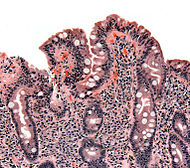
  • Image: Sample of a bowel biopsy showing Celiac disease.

April Fool's Joke; "Classically Conditioning Craig to Salivate"

After hearing about Ivan Pavlov, a biologist/scientist who was able to classically condition dogs to salivate when they would hear a bell ring, Jen & Craig volunteered to go through an "experiment" to see if humans could start to salivate when hearing someone talking about food, and what Mr. C told them to do was:
Jen was to listen closely to Craig's stomach while Craig listened to Mr. C talk about Belgian waffles. Jen was listening for Craig's stomach to 'secrete gastric juices', but all she could hear was Craig laughing and Mr. C talking. We found out later that it was a joke. APRIL FOOLS!

Sunday, March 30, 2008

March 25, 2008, Tara Landsbergen, 3/3

amylase enzyme:
What We Did Today:
  • Intro to Human Organism Unit
  • Are You Ready? Pg. 238 1, 2, 4, 5a, 6ab, 7ab
  • Nutrients
  • Enzymes
  • Preparation for lab, Pg. 274
Thoughts and Opinions:
  • Really exciting that we're finally starting the human body and its functions!!!  
  • The Are You Ready exercise was a bit of a wake up call, but a good one.  
  • Interesting how the enzymes work.
  • Can you overdose with vitamins?

Above and Beyond:
Yes, you can overdose with vitamins.  Overdoses can lead to side- effects like birth defects, osteoporosis, it mostly effects the central nervous system.  Symptoms of Vitamin A toxicity are headaches, dizziness, vomiting, incoordination and blurred vision.
-www.syl.com

Friday, March 28, 2008

March 28th, 2008 Debora Obrist 2/5?/3

What We Did Today:
  • Discussed rewrites on yesterday's quiz.
  • Continued our discussion on the Digestive System.
  • Discussed the 'papple' and how it would get digested after being broken down into dextrin and disaccharides and stuff.
  • Did some questions.
Thoughts and Opinions:
  • How long does gum reeeally stay in your system?
Above and Beyond:
  • Nope, it gets egested just like all other roughage that enters your intestines. -Yahoo Answers.
I was told to put this on here even though it ties into our cellular respiration more than this unit... Click the link!


Monday, March 24, 2008

February 19, 2008 Amy Kidd 3/3

What we did today:

- photosynthesis candy lab
- tried to do a "virtual lab" but it didn't work

Thoughts and Opinions:

It helped to do the lab because it told us how much we actually knew about photosynthesis and what we needed to know for the test.

Above and Beyond:

This is pretty much the breakdown of photosynthesis.


Sunday, March 23, 2008

Feb. 18, 2008 Mikki Johnston 3/3

What we did today:
  1. Went over lab
  2. Worked on the assigned questions
  3. Looked over Candy lab

I can't really remember anything else we did...

Thoughts and Opinions

As we were talking about the paper chromatography I thought about what pigments can tell you about the plant.

Above and beyond

When I was thinking about chromatography I researched about what it tells you about the plant. This is what I found out: It tells you about the pigments in the plant. (Which we knew) In terrestrial plants, chlorophyll's a and b are usually found, along with carotene's and xanthophylls.This sweet website had some information about it so check it out:http://www.madsci.org/posts/archives/1996-12/850157309.Ag.r.html Also check this tight website out:http://en.wikipedia.org/wiki/Paper_chromatography

Wednesday, March 19, 2008

Kimara Gratton, March 17, 3/3

What we did today:

  • Pre-lab quiz page 195
  • Pigment chromatography lab
  • Assignment questions.....there were a lot!!

Thoughts and opinions:

When we were doing the lab i was thinking about what other chemicals were used to bring out different pigments in the spinach.

Above and beyond:

so i was researching and came upon this sweet chart on this tight web site http://shankardyes.tradeindia.com/ where there is a chart telling you all about this sweet stuff!!! ( i tried to copy the chart but it wouldnt copy right)

Thursday, March 13, 2008

Craig Bourgonje, March 12 3/3

What we did:
1. Asked Mr.C questions about cellular respiration.
2. Wrote cellular respiration test.
3. Sat quietly while Vadge drew pictures.
4. Mr.C showed us an article on spinach computers.
5. Looked at slides on cellular respiration.
6. Took a 3 minute break.

Thoughts and opinions:

When we were talking about computers than ran on spinach, I though it would be $#@! WICKED if someone could figure out how to make vehicles that run on vegetables. It made me wonder how green this earth would be if combustion engines were replaced with vegetables engines.

Above and beyond:

The set of spinach proteins, known as Photosystem I, is a well-known component of the photosynthetic process. Until now, however, nobody had been able to figure out how to make them work in combination with electronic circuitry because the proteins cannot survive without water and salt—ingredients that do not mix well with electronics. Zhang solved the incompatibility by creating “detergent peptides,” molecules that form protective shells around the photosynthetic proteins. The peptides seem to hold water inside their shells and prevent it from leaking out. “They keep Photosystem I wet and stable but keep the water away from attached electronics,” Zhang says.

Mitch Bach -- March 10, 2008 -- 3/3

What We Did
  • Handed in Bottle Biosphere Project
  • Chalk and talk with anaerobic and aerobic Cellular Resperation
  • Questions that were not for marks

Thoughts and Opinions:

When we were discussing lactic acid, I wondered if there was some kind of a lethal dose of it, a set amount that could kill an average human. I also wondered if there were any animals that naturally perform cellular resperation anaerobically.

Above and Beyond

According to http://en.wikipedia.org/wiki/Lactic_acid, the highest that it can potentially rise to is 20 mmol/L. Through my understanding, anything greater then that could cause toxic effects, even though lactate doesn't act like a "real" acid. The only kinds of animals/micro-organisms that perform anaerobic are obligate anearobes and facultatave anearobic organisms.

Lindsay Baker, March 11, 2008 3/3

What We Did Today:
  • Finished questions really fast
  • Discussed products of yeast fermentation
    • C02 + ethanol + 2 ATP
  • Discussed products of anaerobic respiration
    • Lactic Acid + 2 ATP
  • Got bottle biosphere project back! WOOO. I did good.
  • Learned that H2S is hella deadly because it blocks off a part of the electron transport chain
  • Prepared for the UNIT TEST! I did not so good.

Thoughts and Opinions:


Everything was pretty interesting. I understood all that junk. I learned you can eat a whole bottle of tums and it's almost like 'roidin'. Without the 'roid rage. I also found that I can't use terms like "whatnot" and "sass" in school projects. Shucks.

Above and Beyond:

Steroids taken for an extended period of time can cause:
  • stunted growth in teens (by causing bones to mature too fast and stop growing at an early age)
  • liver tumors
  • abnormal enlargement of the heart muscles
  • violent, aggressive behavior and mood swings
  • blood lipid abnormalities that contribute to heart disease
  • acne (or a worsening of acne)
  • increased breast growth in males, especially teens
  • irreversible stretch marks
  • a heightened tendency for hair loss and male-pattern baldness
  • muscle aches

Teen girls and women risk these additional side effects:

  • male-type facial and body hair growth and male-pattern baldness
  • deepening of the voice
Sodium bicarbonate, on the other hand, is used to relieve itches from bacterial infections and poison ivy. It can be used to clean your ears when it's in a 10% concentrated solution. It's also used as a base in crack cocaine.

So, if I had to choose between anabolic steroids and chuggin' sodium bicarbonate, I'd do the latter. Even if I had to deal with large doses of diarrhea. (ps; I'm making fun of you, Batch.)

Katie Foster, March 13, 3/3

Today we..
  • received a progress report
  • got our Cellular respiration tests back
  • did a quick quiz on photosynthesis
  • and talked about photo systems in cells

My Thought and Opinions.

Today's discussion made me wonder if there is more than one type of antenna pigments. I also thought about some other differences between photo system 1 and photo system 2, and what those might be. What is ferredoxin? and also, who discovered photo system 1 and 2.

Above and Beyond.

I found by looking at wikipedia that ferredoxin is a compound made of iron and redox. i also found that fossils of what are thought to be filamentous photosynthetic organisms have been dated at 3.4 billion years old. I was unable to find the discoverers of the 2 photo systems.

Monday, March 10, 2008

Kristi Joy Young, March 6/08, 3/3

What we did today:


  • Review Homework - Kreb Cycle

  • ETC text book reading pages 216-19, also handout and animated cycle

  • Quick overview and some notes

  • Double block so we came back and enjoyed a Candy Lab =D made a few of us very happy to be in Bio for that time

  • Finished off the 136 minutes of bio by being handed a take home quiz =(


Thoughts and Opinions


These two classes really helped me to fully understand cellular respiration. The Candy Lab made the four stages a lot more clear on what was happening. I think that you shouldn't use good candy because it just made us kids eat lots and get hyper and then have you yell at us. So really it was your fault we were pretty outrageous. Anyways, these two classes made the four stages of cellular respiration easier to understand by getting further into detail with a hands on activity.


Above and Beyond


Jumbo Gums- One of God's many great gifts to this world....are soft and chewy jelly candies that are made with real fruit juice! They are offered in an assortment of six delicious flavours including orange, lemon, lime, liquorice, raspberry, and pineapple. Ingredients
Glucose Syrup, Sugar, Modified Corn Starch, Apple Juice from Concentrate, Glucose-Fructose/Dextrose, Natural and Artificial Flavours, Colour including Yellow
#5


Well, this has been fun and all but I got some math homework to do so check ya'll latah!

Sunday, March 9, 2008

Cody Vewchar, March 5/08, 3/3

What we did today:

  1. Talked about Pyruvate Oxidation and filled in our diagram in booklet
  2. Mr. C got a caramel chocolate bar and showed us how the four stages of cellular respiration work
  3. We started discussing the Krebs Cycle in more detail and started to fill in our booklets about it
  4. Mr. C had to give us abit of homework and made us finish the diagram about the Krebs Cycle

Thoughts and Opinions

I thought this class was really interesting. I did not know any of it and learned a lot of new stuff. The whole time Mr. C was dividing up that chocolate bar all I could think about was how good it would be to eat it right now. During our discussion about Pyruvate Oxidation and the Krebs Cycle I was wondering how many enzymes it actually takes to perform these processes.

Above and Beyond

In this website http://en.wikipedia.org/wiki/Citric_acid_cycle is lists all the enzymes involved in the citric acid cycle. And in this website http://www.rose-hulman.edu/~brandt/Chem330/Pyruvate_DH.pdf it also talks about some enzymes involved in pyruvate oxidation.

Wednesday, March 5, 2008

Rachel Schneider - March 3, 2008 3/3

A bit late... whatever. :)

What went down on March 3rd:

~Bottle Biosphere project was due (with guide mark)
~Had a quick quick on Active and Passive Transport
~Loads more of notes on Cellular Respiration. Yaaay.

What I thought about what went down on March 3rd:

Well, I need to learn how to remember stuff about active and passive transport. Yes I do.
So Cellular Respiration is pretty difficult.. I'm glad we don't have to write too many notes like we did in grade 10...
But as crazy as all this stuff is, it's interesting.

Darn it, Melissa beat me to 'Infinity and Beyond'... I wanted to be Buzz Lightyear first:

So during the class, Mr. C was talking about that Krebs dude, Hans Adolf Krebs is his name, and how he came up with the citric acid cycle in, when was it, 19-freakin'-37?! I really don't know how he managed to come up with that stuff back then, or any scientists for that matter. Then again, it was probably quite basic compared to now, seeing as there's so much technology now-a-days to discover more parts to cycles and what not. I'd love to go look up how they did it, but that's kind of a difficult subject to look up if you ask me.. (or I'm just being lazy..) But click here to see a whole buch of stuff on Hans Adolf Krebs. And here's a picture of that lovely cycle that crazy guy discovered (what a genius!):


-Rachel, a 'kick butt' Bio 20 student.
Oh right.

Tuesday, March 4, 2008

Hayley Tarnasky, March 4/2008-- 3/3


What we did:


  • First off we got to listen to Mr.C explain some background information about fats, lipids, proteins and carbohydrates

  • Then Mr.C gave us a booklet of handouts

  • After he got reorganized, he turned on the overhead projector and put on a transparent version of the first sheet!

  • He explained about the 4 Stages: i)Glycolysis- which happens to be located in the cytoplasm

  • ii) PAC(or Pyruvic Acid Conversion/Pyruvate oxidation)- located in the inner membrane/ mitochondria matrix

  • iii) Krebs Cycle( aka citric acid cycle)- mitochondria matix

  • iv) Energy Transport Chain ( cytochrome system)- in the mitochondria
  • We got to learn about ATP and ADP

  • Listened to Mr. C talk about the order of the 4 stages

  • Learned the analogy of the "H" and taxis and then repeating until theres a lot of "H"s

  • Filled in the first two pages of the worksheet

  • Looked at the diagram of Glycolysis

  • Finally, the bell rang

  • That is a lot of stuff to remember!


Thoughts/ Opinions


  • I think that the overhead was a good method of showing us the diagrams

  • It was for sure a good idea to give us the background information

  • Is it possible for humans or plants to survive without ADP and ATP?


Above and Beyond:


Saturday, March 1, 2008

Melissa Schneider, Feb. 29/08, 3/3

AHA, I get to do a blog post on Leap Day.
Well, sort of, since it's actually March 1st . . . darn. Why did I have to forget about the blog yesterday?

What We Did Today (yesterday):

  1. Wrote the Unit 1 Test. (food chains/webs, trophic levels, energy transfer; N, P & C cycles, etc.)
  2. Marked the Unit 1 Test.
  3. Was assigned Are You Ready? questions on page 176 (review for quiz on Monday), and to read pages 207-209 in textbook.
  4. Was reminded that Bottle Biosphere project is due on Monday. (Mark your own project before handing it in!)

Thoughts & Opinions:

  • The test was "easy peasy", which meant that Mr. C taught the right stuff!
  • Err, we didn't learn anything new, so I don't know what else to say. . .

TO INFINITY AND BEYOND:

A random piece of Bio information for you all . . .

This site: http://www.geocities.com/ultrastupidneal/Knowledge-Biology-Fact.html says that at 200 degrees Celsius, sucrose will melt into caramel! I know, WOW, right?


A very complicated equation of caramel. kthxbai.

Thursday, February 28, 2008

Debora Obrist - February 28th. 3/3

What we did today:
  • It was a repeat day, sooo we did a lot.
  • Finished our game of jeopardy. My congratulations to team Hottie Alert! =D
  • Reviewed photosynthesis / cellular respiration.
  • Did Are You Ready? questions on page 176.
  • Did questions on page 202.
  • Took notes on ATP. -what it is, how it's used and made.
  • Squeezed pens and made charts and answered questions about it.

Thoughts/Opinions.

  • I think in the future, actual clothespins should be used instead of pens.
  • Are there any artificial ways of getting ATP into your body, without cellular respiration?

Above and Beyond:

Wednesday, February 27, 2008

Tara Landsbergen, February 25th, 3/3

What We Did Today:

  • Missed Mr.C
  • Had to put up with the Haus
  • Started and worked on our Bottle Biosphere project
Thoughts And Opinions:

  • I thought that the Bottle Biosphere project was interesting and fun.  It was also a good way for us to think about and review the biogeochemical cycles and the different trophic levels that we learned about earlier in the unit.  I do wish we could actually make one for real!!!
  • Could closed artificial biospheres sustain human life??
Above And Beyond:

  • A Biosphere Project was built in Arizona at the cost of $200 million US.  The scientists had tried to build a 3-acre Earth containing a desert, rainforest and even an ocean.  There were many problems though.  One of them being oxygen levels.  They started declining at 0.3% per month.  CO2 levels were extremely unstable as well.  They ended up having to pump pure oxygen into the biosphere, hence now destroying the "closed" system.  4 men and 4 women lived in this artificial biosphere and came out extremely depressed and malnourished.  This was after two years of living in the artificial biosphere.
website:  http://ieet.org/index.php/IEET/more/dvorsky20070203/

Picture of Biosphere 2 Project

Sunday, February 24, 2008

Rachel Klapp 3/3

This is what we did in class on wednsday:


  • Had a qucik quiz.

  • Marked our questions from the text book on the nitrogen cycle.

  • Completed two work sheets on the phosphorus cycle.

  • Watched a little demo on the phosphorus cycle.

  • The bell rang while we were watching the demo so we will coninue on Monday.

Questions and Comments:


  • I learned that the phosphorus cycle does not exist in the atmosphere.

  • Are the phosphorus types of bacteria like there is nitrifying bacteria?

Above and Beyonndddddddddddddd:

There is suposed to be a picture here. I uploaded it twice from my desktop.


Saturday, February 23, 2008

Amy Kidd, February 19 -- 3/3

What we did today:

Looked at the nitrogen cycle.
- did 2 worksheets.
- looked at the different types of bacteria in the cycle, and their functions.

Thoughts and Opinions:

What is the difference between nitrogen fixing bacteria and ammonifying bacteria? They do the same thing, so why are there 2 of them?

Additional Insight:

- All life requires nitrogen-compounds. ex: proteins and nucleic acids.
- Air, which is 79% nitrogen gas (N2), is the major reservoir of nitrogen, but most rganisms cannot use it in this form.

- Plants must secure their nitrogen in "fixed" forms, such as:
- nitrate ions (NOx)
- ammonia (NH3)
- urea (NH2)2CO


Monday, February 18, 2008

Mikki Johnston Feb.15,2008 3/3


What we did today!


  • Looked at Carbon Reservoirs Questions from Yesterday

  • Talked about Global Warming

  • Talked about Greenhouse Effect

  • Watched a clip of a video about something (Global Warming and Core samples and stuff)

Thoughts about the class

Well as we were watching the video about the Greenhouse effect or what not I wondered about how can core samples can tell you about the Earth ?!?


Additional Info

Ok so the core samples are layers of snow compacted over time and each layer tells you something about the Earth. It's like telling the history of the planet through snowly layers! Core samples also can be taken from trees rings and from the ocean floor. The core samples can tell you if there had been an ice age, drought and all sorts of stuff.

"A core sample is a cylindrical section of a naturally occurring medium consistent enough to hold a layered structure." -http://en.wikipedia.org/wiki/Core_sample


Sources:
http://en.wikipedia.org/wiki/Core_sample

http://www.mnr.gov.on.ca/MNR/ogsr/images/core_library.jpeg

Sunday, February 17, 2008

Carbon cycle, Kimara Gratton, Feb 14-08,

What we did today:
  • Marked lab questions
  • Chapter two quiz
  • Talked about the carbon cycle
Thoughts and opinions:
I thought about what percentage of carbon dioxide plants took in compared to people.

Above and beyond:
I couldn't find what percentage of carbon dioxide plants took in compared to people, but i did find this web site http://en.wikipedia.org/wiki/Carbon_cycle that said that oceans contain 36,000 gigatonnes of carbon mostly in the form of bicarbonate ion. I found this kind of interesting.

Thursday, February 14, 2008

What we Did;
we talked about the hydrological cycle
we talked about acid depostion
read page 46
we did a thought lab
and answered questions

Thoughts and Opinions;

I thought about how many rovers have been sent up into space to search for life and what has been found. I also wondered about different water currents and which ones carry the most heat. Which ones move in and out of Canadian bodies of water? And which ones? I wonder how deep the water table is in different regions on earth and how that effects the types of organisms that exsist there. I also wondered if there are any mountains in the eastern provinces that do neutralize acid rain in any way.

Above and Beyound;

After reading about tides on http://www.lau.chs-shc.gc.ca i found that some tides occur in the great lakes of canada. although mostly small and insignificant, they do occur. I also read about reversing falls. a phenomenon in which the tide rises higher than the water fall and the water seems to be flowing backwards. Canada's 3 reversing falls are the saint john river, wager bay and Barrier inlet.

Wednesday, February 13, 2008

Lindsay Baker (2/3)

THIS IS WHAT WENT DOWN TODAYYYY.

first, we did a pre-lab quiz. but i didn't. i wasn't there the day before.
then we did the lab where we pretty much just burnt up some food. i learned that carby things got a lot of food energy. more than simple sugars, y'know? and i am ultra-pro at burning pumpkin seeds. i'm wondering if i did the whole thing right, because i had answers in the 1000-3000 range and then i got one thing that was like 6283. or somethin'. the point is that junk food has alot of unnutritiousness and you should probably eat some seeds instead.
then we marked the thing with the water budgets with the kangaroo rat and the people and i found that people sure do pee alot.
we also got a sheet on the carbon cycle. somebody said a stage of the cycle was "bear". let me show you a bear.


it's standing. i wonder how much bears sweat? i know that bears smell pretty bad, but i don't think it's sweat. it's probably people parts. in their belly. WOO WOOOOO!

Monday, February 11, 2008

Craig Bourgonje, February 11 2008, 3/3

What We Did:
  • Looked at Vadge's blog (Mitch will hit me for that).
  • Reviewed lab.
  • Handed in lab.
  • Looked over assigned questions.
  • Watched video clip about prescribed burns.
  • Looked at hand out.
Thoughts and opinions:

Todays class was mostly boring, despite watching a video clip, which wasted a small portion of the class. The better part of the class was spent reviewing homework, which I am great full it was not for marks.

Above and Beyond

Fire has played a major role in determining the distribution of plants across the South. Some plant communities such as cypress swamps survive for centuries between prolonged droughts that finally allow stand replacement fires to enter. Other communities such as the once vast expanse of longleaf pine burn every few years. In fact some ecosystems, for example the longleaf pine-wiregrass association, require periodic fire for their very survival.

http://geology.isu.edu/geostac/Field_Exercise/wildfire/images/Prescribed-Burn.jpg


http://www.youtube.com/watch?v=nvBORoVWuM4

Sunday, February 10, 2008

Mitch Bach -- Feb 8,2008 -- 3/3

What we did:
  • Pre-lab Quiz.
  • Went over the lab sheet -- Photosynthesis in Plants.
    Did the lab.
  • We took notes on Limits in energy.
  • Read and took notes on Pyramids in Ecosystem.
  • Practise Questions -- Pg. 31/32 Q. 1-3

Thoughts and Opinions:

When we were doing the lab, I wondered if there were any other indicators for evidence of starch. I also wondered which plant absorbes the most sunlight in photosyhnthesis throughout the world. Overall, I think that the lab was a complete success.


Above and Beyond:

Throughout the web, I couldn't find a site that said that other indicators can be used to trace starch. However, http://en.wikipedia.org/wiki/Starch_indicator says that starch is used to find traces of iodine element and ion, which makes sense.


I was unable to find which plant absorbs the most sunlight, but because it is the chlorophyll in plants where photosynthesis occurs, it would be the plant with the greatest concentration of chlorophyll in it. It would probably be a plant where a lot of water is found nearby, because water constantly reflects, refracts, and magnifies sunlight.


Chloroplasts, the major sight of photosynthesis.

Wednesday, February 6, 2008

Mr. C, Feb.6/08, 3/3


What we did today:
  1. quick recap of caffeine research findings

  2. discussion about terms introduced yesterday (biosphere, dynamic equilib, "mantra")

  3. discussion about importance of biodiversity to maintaining dynamic equilibrium in the biosphere (included reading about frogs as indicator species: p12-14)

  4. went over requirements for Blog (begins tomorrow)


Thoughts about the material:

Our discussion made me wonder about the biodome project (why didn't it work?), how many organisms can exist in a given food chain (is there a max # of "links"?), and just how thick is the biosphere (other than "saran wrap"). It's hard to believe that this small region is the only place that life exists in the universe.


Above and beyond:
According to this site: www.en.wikipedia.org/wiki/biosphere the average thickness of the biosphere is about 5400m above sea level to 9000m below sea level. That's 14.4km - not very thick (you could walk that far in about an hour and a half!).

Note: some organisms have been recorded outside of this range - at least temporarily e.g. Ruppels vulture found at 11,300m! (Mt Everest is 8850m) and some fish found at -8372m! (10,000psi of pressure!). Most organisms at the extremes of the biosphere are simple, single-celled bacteria.

The picture shows a charming baby octopus found deep in the ocean.

Tuesday, January 29, 2008

Welcome to Mr. C's Biology 20 site!


Hello Bio20,

This blog site will serve as a place to archive our progress in Bio20, to table concerns and/or questions, to offer additional thoughts or comments, or simply to "dump" on the course/content/teacher/classmates.

You will be expected to submit several postings during this course. Mr. C will provide a schedule of who is responsible each day.

Postings will be graded as an assignment.

As a minimum (1st mark) you should provide a brief review of what we did in class that day (bullet points are recommended).

Additional credit (2nd mark) will be given for providing thoughts about the material (e.g. where the topic(s) apply to real life, questions that remain unanswered, extensions on topics discussed, connections to other topics or courses, etc...
UNACCEPTABLE = "I thought the class was good").

Full credit (3rd mark) will be given for doing the first two requirements, AND going 'above and beyond' (e.g. providing additional information, links to other relevant sites, photos, etc...).
NOTES:
Admin:
1/ WRITE YOUR NAME AND THE DATE OF THE DAY BEING DISCUSSED IN THE TITLE LINE
2/ CLEARLY indicate each requirement with headings. Example: Review of material covered...... Thoughts on material..... "Above and beyond"...
3/ AT THE END OF YOUR POSTING, GIVE YOURSELF A MARK OUT OF THREE (see marking guide above). YOU WILL BE ASKED TO JUSTIFY YOUR MARK IF IT SEEMS UNWARRANTED.
4/ ENTRIES MUST BE POSTED WITHIN 5 DAYS OF THE CLASS (including weekends) OR A GRADE OF ZERO WILL BE ASSIGNED.
I will give you a reminder "comment" if you miss something in your first entry, but you will lose a mark for missing info on the second.

Feel free to have some fun with this site, but rudeness will not be tolerated ;(
Have a great day!
Mr. C